
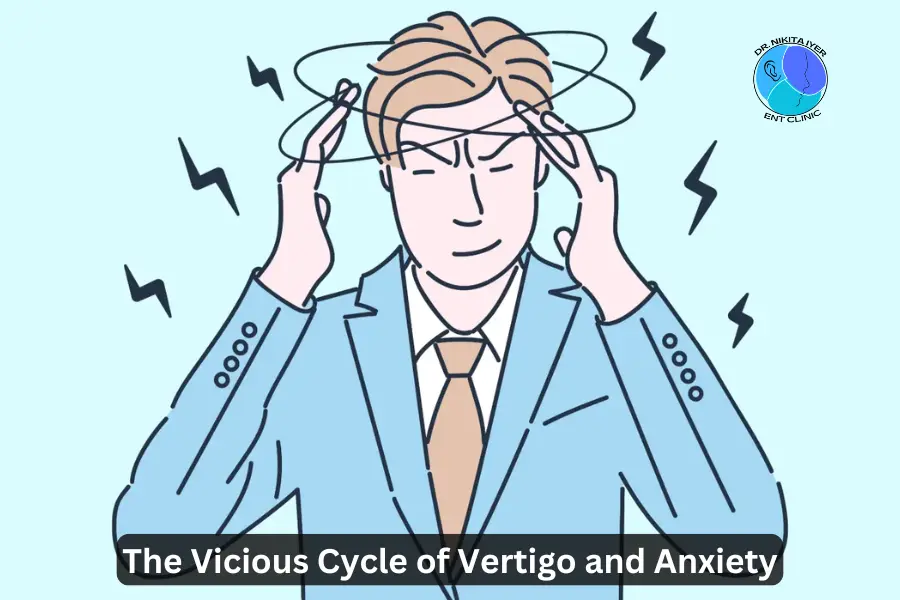
More than merely feeling dizzy, vertigo is the uneasy feeling that your environment or yourself is rotating, tilting or otherwise moving when it is not. Many individuals experience both vertigo and anxiety simultaneously, reinforcing one another and leading to difficulty breaking the cycle.
The inner ear is the primary area involved when experiencing vertigo. This area of the body helps maintain equilibrium or balance. Inner ear health concerns, such as benign paroxysmal positional vertigo (BPPV), vestibular neuritis, or inner ear infections, can send conflicting information to your brain and result in a sudden onset of spinning, loss of balance, and nausea. When experienced without any prior warning, these symptoms can cause immediate distress.
In this blog, Dr Nikita Iyer, a leading vertigo doctor in Chembur, explains the correlation between vertigo and anxiety.
Experiencing fear with vertigo is what gives rise to anxiety. After experiencing one of two episodes of vertigo, individuals will often begin to have continual fears about when their next episode will occur. Knowing that their episodes may be imminent, people begin to experience increasing levels of anxiety, leading to physical sensations including a rapid heartbeat, difficulty breathing, excessive sweating and feelings of loss of control. The difficulty arises when attempting to differentiate between vertigo symptoms and those of anxiety, particularly when the symptoms of anxiety are similar to those of vertigo.
People who experience anxiety may also experience greater sensitivity to sensations of imbalance in their bodies. Dr Nikita Iyer, the top vertigo doctor in Tilak Nagar, explains that when a person experiences anxiety, the brain becomes hyper vigilant, scanning for possible threats in your body. This increased sensitivity often exaggerates even a very mild sense of imbalance; the feeling of dizziness seem to be worse than they actually are. For many individuals, this will lead to avoidance of activities that require balance, such as driving, walking in crowded spaces or turning your head quickly; this can create a cycle of decreasing balance control.
The stress hormones that are released during anxiety episodes can have a physiological effect on blood flow, muscle tension, and breathing patterns. The result of shallow breathing combined with a tense neck can create more lightheadedness, which can cause more head pressure and lead back into vertigo symptoms; thus creating a self-perpetuating cycle, vertigo leads to anxiety, anxiety leads to increases in dizziness, and the fear of the symptoms creates an even stronger cycle.
Breaking the cycle requires attention to both the physical and emotional parts of the individual. The first step is to achieve an accurate diagnosis. All dizziness is not the same. It is important to determine the cause of the dizziness, such as inner ear problems, migraine-related vertigo or other causes, to provide an effective treatment plan. Treatments such as vestibular rehabilitation exercises, repositioning manoeuvres, or medication have demonstrated significant reductions in the duration of vertigo episodes.
Equally significant is addressing anxiety. Education is important for this process, as part of understanding the syndrome of vertigo and/or dizziness, one learns that though it may cause distress, it is typically not unsafe in and of itself, thus diminishing any fear associated with it. To retrain one's brain regarding their response to dizziness, one may utilise various techniques, such as relaxation training, breathing exercises, or gradually exposing oneself to the movement one has avoided doing as a result of panic or fear (and in some cases may benefit from seeking psychological support)
If experiencing dizziness or vertigo adversely affects your everyday life by triggering panic attacks or causing you to avoid engaging in daily routines, you should reach out for support. Book a consultation with Dr Nikita Iyer, the top specialist for vertigo near me today as early intervention will help keep from developing a chronic condition and help restore self-trust in functional movement and balance.