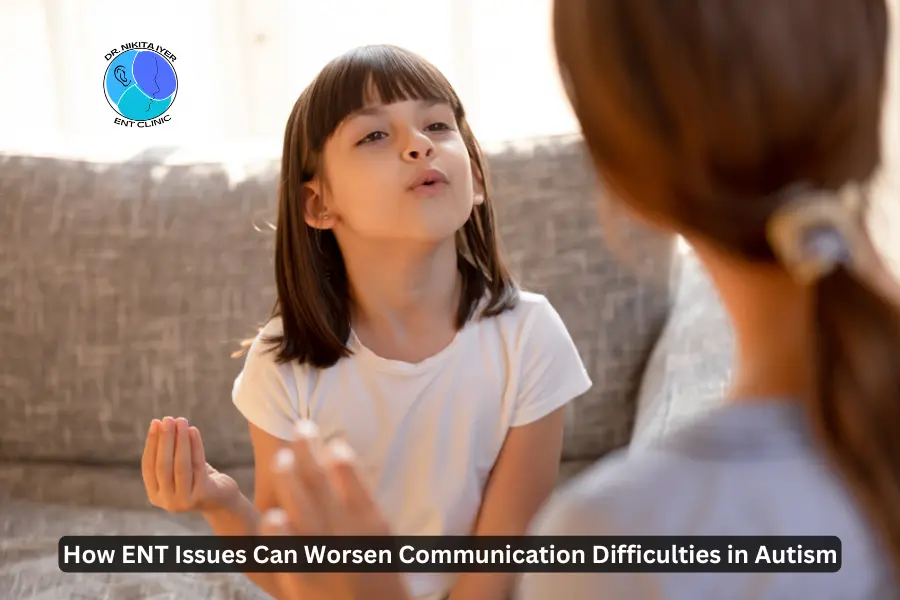
Each year on Autism Awareness Day, we are reminded how important it is to support and understand those individuals who fall within the Autism Spectrum. As per Dr Nikita Iyer, a leading ENT otorhinolaryngologist, the majority of focus is directed toward behavioural, social, and developmental issues associated with autism. It is also equally important to recognise that physical health can greatly affect children with autism's ability to communicate, especially their ENT (ear, nose, throat) health.
For instance, children diagnosed with Autism encounter many different types of communication difficulties, including delayed speech, difficulty understanding language, reduced social interactions, etc., but it is also common for these communication difficulties to be exacerbated by an underlying ENT condition one may not realise exists. When we begin to identify and treat these types of conditions, we can greatly improve an individual's ability to communicate in a more effective manner.
The most common ENT-related issues children with autism face are with their hearing. Hearing impairments (even if mild) can greatly affect a child's ability to hear properly (process sounds and speech), which may delay progress in speech and language development. This would be especially difficult for children with autism, as they may already be having difficulty developing language skills, making hearing loss one more barrier to further delay such development and additionally contribute to frustration and/or withdrawal.
Chronic ear infections are another factor that can worsen communication difficulties. These infections may not always be obvious, especially if a child has trouble expressing discomfort. Signs such as irritability, lack of response to sounds, or changes in behaviour can sometimes be misinterpreted as autism-related traits, rather than symptoms of an underlying medical issue.
Sensory sensitivities are common in autism, and ENT problems can intensify these experiences. For example, sound sensitivity may become more severe if there is pressure or blockage in the ear, causing ordinary sounds to feel overwhelming. This can lead to avoidance of communication or social interaction, further impacting language development.
Issues related to the nose and sinuses can also affect communication. Persistent nasal congestion or sinus infections may interfere with speech clarity, making it harder for a child to articulate words properly. Additionally, discomfort from sinus pressure can reduce a child’s willingness to engage in conversation or learning activities.
Throat problems, such as enlarged tonsils or frequent throat infections, may cause children to have a difficult time communicating through speech and swallowing as well as an inability to use their voice effectively or with clarity (i.e., hoarseness, speech production). Even when sleep problems are not an issue, children suffering from these conditions may frequently experience fatigue associated with communication-based interventions due to the impact these conditions have on their ability to communicate.
A second contributing factor in children who have a problem communicating, which is often underestimated, is that they may also have difficulty breathing. Many children breathe primarily through their mouths due to nasal blockage, resulting in altered vocalisation patterns and increased vocal strain or reduced vocal clarity. Similarly, the quality of their sleep can also be adversely affected by their inability to adequately breathe through their nose, resulting in impaired cognitive function and communication skills.
While it is easy to assume all communication disorders in children with autism are neurological, many may be either caused or exacerbated by treatable ear, nose, and throat conditions. Identifying and treating these additional limitations as early as possible decreases the additional barriers to effective communication and allows children to better engage in speech therapy, education, and social interaction.
On this special day to honour children with autism, we want to provide you with suggestions of things you can do to help your child. If you have a child exhibiting some of these symptoms such as: not responding when being called by name, frequent ear infections, difficulty with speech/communication skills, persistent clear nasal drainage or nasal congestion, or experiencing any sleep disorders; you may want to schedule an appointment for your child to see an Ear, Nose and Throat (ENT) Specialist to rule out any medically-related issues that would indicate the need for additional support.
Call today to make an appointment with Dr Nikita Iyer, the top ENT and one of the best allergy and asthma doctors near me, to begin to improve your child's ability to communicate and live a higher quality of life.